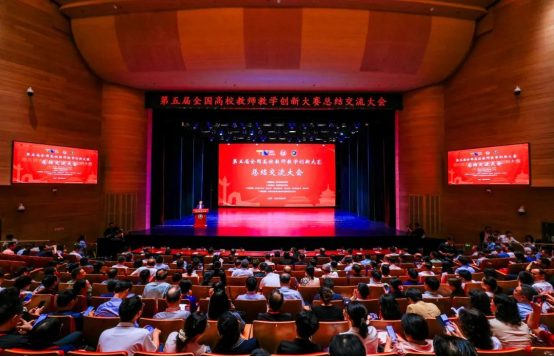
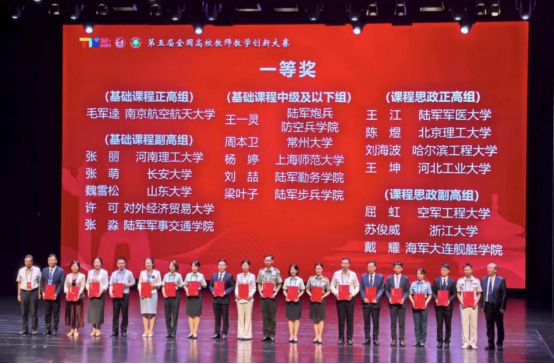
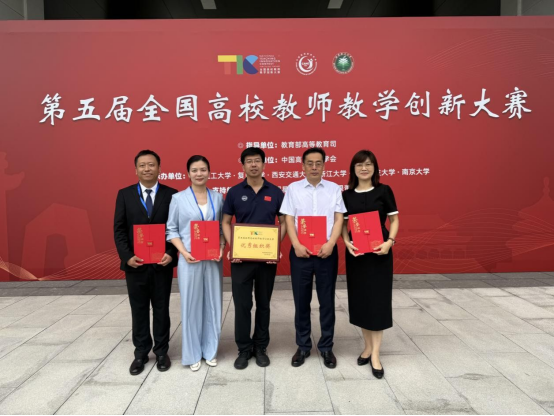
On August 19 2025, the 5th National Teaching Innovation Contest, guided by the Department of Higher Education of the Ministry of Education and organized by the China Association of Higher Education, successfully concluded. Faculty teams from Harbin Engineering University (HEU) achieved remarkable results, securing one First Prize and three Second Prizes. The university also received its first-ever Outstanding Organization Award, ranking third nationwide among participating institutions.
Professor Xiaoying Wang and her team from the School of Mathematical Sciences won the Second Prize in the “Basic Courses (Professor Level)” category for Linear Algebra and Spatial Analytic Geometry.
The National Teaching Innovation Contest is the only teaching competition included in the Ministry of Education’s List of Approved Competitions and represents the highest-level teaching contest in China. The 2025 edition, themed “Promoting Teaching Innovation and Cultivating Top Talent”, officially launched in March and attracted 127,000 faculty participants from undergraduate institutions across all disciplines. Following the provincial rounds, 34,000 faculty participants advanced to the next stage, with 2,253 finalists (including teams) competing at the national level.
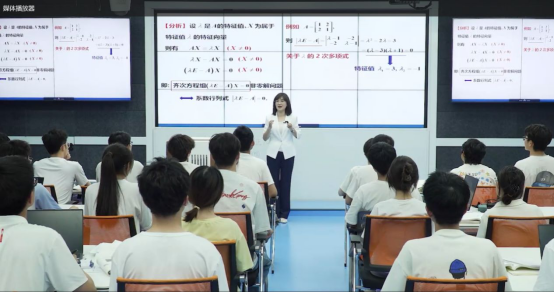
Professor Wang delivered a keynote address on “Transforming Mathematical Cognition into Applied Competencies”, highlighting innovative advancements in the course “Linear Algebra and Spatial Analytic Geometry”. The instructional team developed a multidimensional integrated content framework, established a “data-driven intelligence-enabled” educational resource platform, and pioneered a “three-phase progressive” pedagogical model. These initiatives aim to enhance the mathematical reasoning of the students, engineering problem-solving skills, and a sense of mission aligned with maritime power development. The exploration of novel concepts, models, and methodologies for foundational mathematical education within the context of emerging engineering disciplines provides valuable insights for curriculum reform and pedagogical innovation in basic mathematics education.



 中文
中文
